
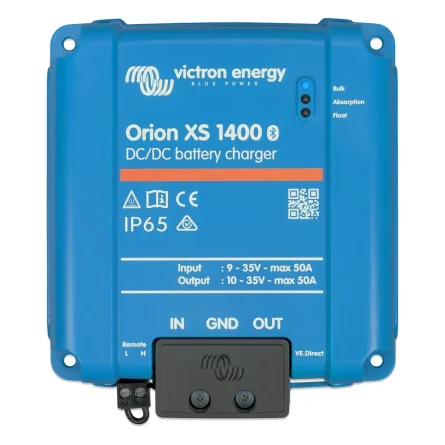
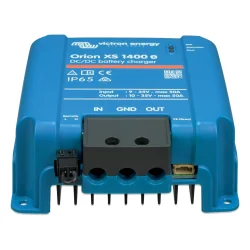
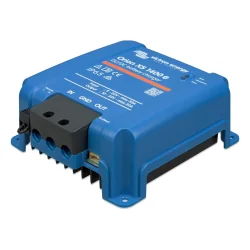
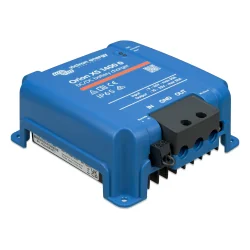
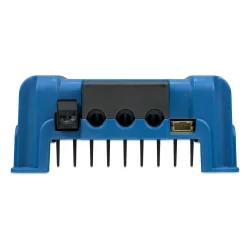
Dimensions: 138.1 × 124.4 × 53 mm (height × width × depth).
Victron Orion XS 1400 50A: DC-DC booster charger for 12/24 V systems, including conversion between both voltages. Input 9–35 V, adjustable output 10–35 V and current from 1 to 50 A. Bluetooth, VE.Direct and IP65. Up to 1,400 W at 28 V and 50 A, subject to input limits and cooling. Reference: ORI242417040.

Charging technologies: Flooded lead-acid, AGM, gel and LiFePO4; select the appropriate charging profile.
EAN/GTIN: 8719076064848
The Victron Orion XS 1400, catalogue reference ORI242417040, charges an auxiliary battery from another DC circuit, either at the same nominal voltage or converting 12 V to 24 V or 24 V to 12 V. It suits work vehicles, campervans, motorhomes and boats with batteries and supplies requiring different voltages.
Supports the following rechargeable battery technologies, provided that the bank voltage matches the charger output and the battery capacity and permitted charging current are respected.
| Technology | Compatibility and settings |
|---|---|
| Conventional flooded lead-acid / WET | Compatible with the lead-acid programme specified by the battery manufacturer. |
| AGM / VRLA | Compatible. Use the absorption and float voltages recommended for the battery; AGM batteries do not all require the same settings. |
| Gel / VRLA | Compatible with the correct gel profile and voltage limits. Avoid overvoltage and reconditioning unless authorised by the battery manufacturer. |
| LiFePO4 lithium | Compatible with the lithium/LiFePO4 profile and a suitable BMS. Do not use lead-acid equalisation or reconditioning. |
Set the unit to charger mode and select or customise the battery profile in VictronConnect. Power supply mode does not replace a correctly configured charging profile.
Not intended for non-rechargeable cells, NiMH or Ni-Cd batteries. Chemical compatibility does not mean that every capacity or voltage is suitable. For LiFePO4, also observe charging temperature limits and BMS protections.
The Victron Energy Orion XS 1400 DC-DC battery charger, also called XS1400, is reference ORI242417040. It combines charging regulation and voltage conversion for nominal 12 and 24 V circuits. The number 1400 identifies rated output under specified conditions; it does not mean every battery bank receives 1,400 W.
It is an option for recharging a service battery in a motorhome, campervan, boat or work vehicle when the electrical design needs flexible voltage conversion. If both input and output are 12 V and you need more than 50 A, compare the XS70. The intended use alone does not determine compatibility.
The 1,400 W rating corresponds to 28 V and 50 A output. At 12 V and 50 A, output is 600 W; at 14 V and 50 A, 700 W. Available power depends on voltage and system limits: it is not 1,400 W under all conditions or 50 A at 24 V from any 12 V supply.
When stepping voltage up, the maximum input current also limits available power. Alternator and supply sizing must consider input energy, losses and vehicle loads, not only the maximum output figure.
| Adjustable input / output voltage | 9–35 V DC / 10–35 V DC |
|---|---|
| Adjustable input and output current | 1–50 A; fine adjustment in 0.1 A steps |
| Rated power | 1,400 W at 28 V and 50 A |
| Maximum efficiency | 98.5 % |
| No-load / standby current | <100 mA / <1.5 mA |
| Output tolerance / ripple | ±0.25 % / 10 mV RMS |
| Protection / cooling | IP65 / natural convection, fanless |
| Dimensions, height × width × depth | 138.1 × 124.4 × 53 mm |
| Net weight | 0.520 kg |
| Operating temperature | −20 to +60 °C; output derating of 1.5% per °C above 40 °C |
| DC connection | Screw terminals; specified maximum: 4 AWG (21.2 mm²) |
Buck-Boost regulation controls output as input voltage varies within the permitted range. Charger mode uses a programmable charging profile; power-supply mode maintains a set voltage for a compatible load. Check the battery and system requirements before changing between these modes.
In a 12 V campervan with 24 V services, or a boat with circuits of different voltages, check the current actually available on each side. Compatibility is not determined solely by vehicle type. This unit has no galvanic isolation.
Bluetooth and VictronConnect provide local settings and readings. VE.Smart receives compatible sensor data without synchronising charging between Orion XS units. VE.Direct integration with a GX enables remote monitoring through VRM when the GX has Internet access. DVCC requires a compatible configuration and, according to the manual, Orion XS v1.03 and Venus OS v3.20 or later.
The lithium low-temperature lockout needs battery-temperature data shared by compatible equipment. If a BMS controls charging, its limits govern the system. Do not assume charger ambient temperature always represents cell temperature.
The current manuals describe temporary charging of the starter battery from the auxiliary battery, up to 25 A, with specific conditions for 12/24 V systems. It requires Orion XS firmware v1.15 and VictronConnect v6.43 or later. Check charger mode, configured voltages and limits before use. It is not a jump starter and cannot guarantee recovery of a flat or faulty battery.
The manual specifies vertical mounting with terminals down, a non-flammable surface and at least 10 cm clearance around the unit. Select fuses and wiring for the actual circuit; do not simply copy XS70 values. IP65 does not permit immersion or remove marine installation precautions.
According to the manual, the box includes the charger and remote connection terminal block. Check the dimensional drawing and manufacturer's documentation for mounting, connections and accessories.
Is it a 1,400 W unit for a 12 V circuit? No. Power depends on voltage and current. Rated output of 1,400 W is specified at 28 V.
Can it convert 12 to 24 V? Yes, within its input, output and power limits. That conversion does not mean 50 A is always available at the 24 V output.
Is it better than the XS70? Compare the XS70 if you need higher current at 12 → 12 V. The XS1400 serves a different need: flexible 12/24 V conversion.
Does it have fans? No. The manual describes natural convection. Maintain the specified installation ventilation.
Compare the Orion XS 12/12-50A and Orion XS 70A. Explore DC-DC converters and chargers, LiFePO4 batteries and battery monitors. Read the official XS1400 manual and explore the Victron Energy range before making your choice.
Documentation: official datasheet PDF, dimensional drawings in the manufacturer's download centre, automotive R10-6 EMC certificate in the manufacturer's download centre. EMC approval does not replace electrical and installation compatibility checks.
| Model | System and current | Selection criteria |
|---|---|---|
| Orion XS 12/12-50A | 12 → 12 V, up to 50 A | IP65 and fanless cooling. |
| Orion XS 12/12-70A 1000W | 12 → 12 V, up to 70 A | IP20, two fans and a dry indoor installation. |
| Orion XS 1400 50A | 12/24 V systems, up to 50 A | 1,400 W rated at 28 V; IP65 and natural convection. |
| Orion-Tr Smart 12/12-30A isolated | 12 → 12 V, 30 A | An alternative where galvanic isolation is required. |
Orion XS chargers do not provide galvanic isolation. Choose according to voltage, permitted charging current, installation environment and electrical design, not just the type of vehicle.
Explore the Victron Energy range, DC/DC converters and booster chargers and our battery chargers and power supplies. For the service battery bank, see LiFePO4 batteries and battery monitors. Choose the model and installation accessories according to the conditions in the official manual.

Data sheet
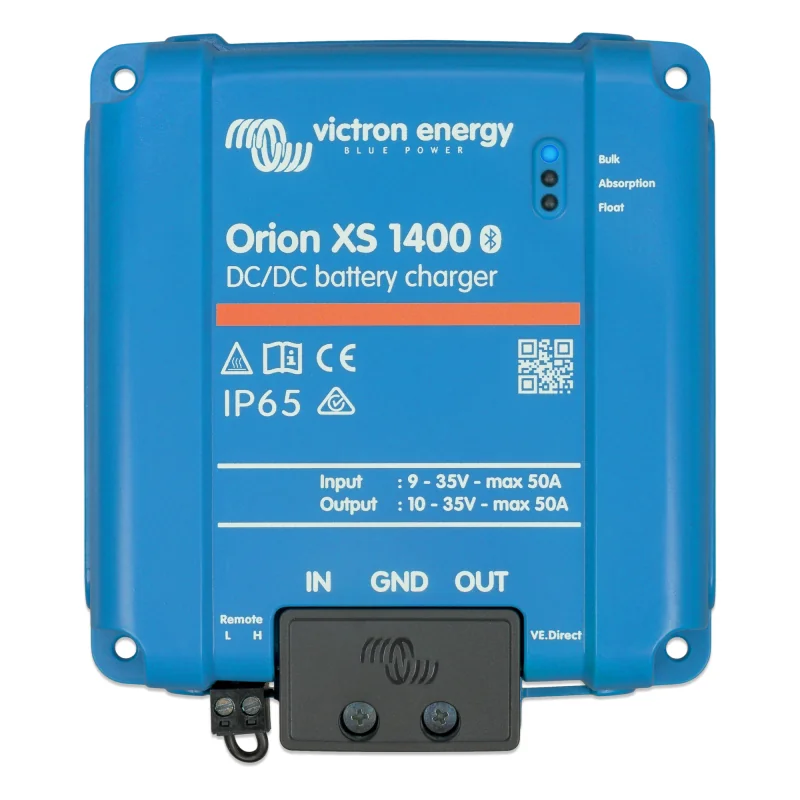
Dimensions: 138.1 × 124.4 × 53 mm (height × width × depth).
Victron Orion XS 1400 50A: DC-DC booster charger for 12/24 V systems, including conversion between both voltages. Input 9–35 V, adjustable output 10–35 V and current from 1 to 50 A. Bluetooth, VE.Direct and IP65. Up to 1,400 W at 28 V and 50 A, subject to input limits and cooling. Reference: ORI242417040.
Charging technologies: Flooded lead-acid, AGM, gel and LiFePO4; select the appropriate charging profile.