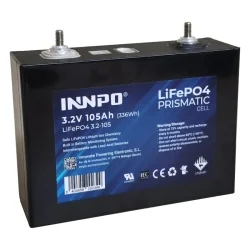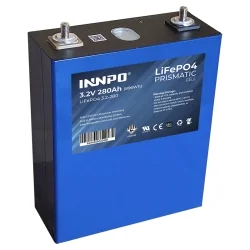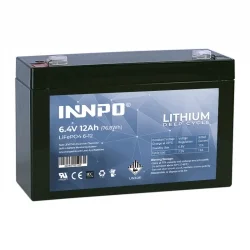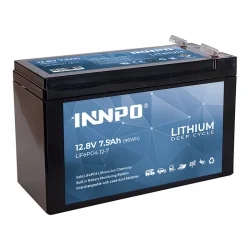

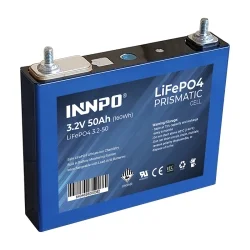
INNPO 3.2V 50Ah Prismatic LiFePO4 Cell
Ah
V
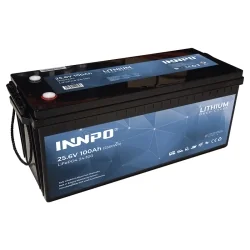
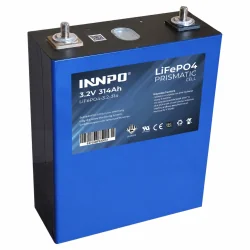
LiFePO4, also called lithium iron phosphate or LFP, is a rechargeable lithium chemistry used in solar storage, off-grid systems, motorhomes, boats, mobility equipment, backup power and custom battery banks. This category includes complete batteries and individual prismatic cells; they are not interchangeable products and require different levels of system integration.
| Format | Best suited to | What must be checked |
|---|---|---|
| Complete 6.4V, 12.8V or 25.6V battery | Compatible service, solar, marine, mobility and backup systems | Charger profile, BMS current limits, terminals, dimensions and permission for series or parallel use |
| 3.2V prismatic cell | Engineered 12.8V, 25.6V or 51.2V packs | External BMS, cell matching, busbars, enclosure, fusing, compression or retention and professional assembly |
Start with energy rather than amp-hours alone. Multiply each appliance power in watts by the number of hours it operates per day. Add the results to obtain daily watt-hours, then allow for inverter and wiring losses, the required reserve and the number of days of autonomy.
Nominal energy (Wh) = nominal voltage (V) × capacity (Ah). A 12.8V 100Ah battery stores about 1,280Wh nominal. A 25.6V 100Ah battery stores about 2,560Wh, so batteries with the same Ah rating can contain very different amounts of energy.
The final battery should not be chosen from 740Wh alone. Consider inverter efficiency, seasonal production, charging time, days without solar input and the operating limits of the exact battery.
Higher system voltage reduces current for the same power. This can make cable sizing and voltage drop easier in medium and large installations. Keep 12V for compatible low-power equipment and existing mobile systems; consider 24V or 48V for larger inverters and storage banks after checking every charger, controller, inverter and DC load.
| Nominal system | Typical LiFePO4 arrangement | Common use |
|---|---|---|
| 12.8V | One complete 12.8V battery or four matched 3.2V cells | Camper, marine and small off-grid systems |
| 25.6V | One complete 25.6V battery or eight matched 3.2V cells | Medium-power solar, mobility and backup |
| 51.2V | Sixteen matched 3.2V cells | Residential ESS and larger inverter systems |
A Battery Management System monitors and protects the battery at cell level and controls charging or loads when operating limits are reached. Complete batteries may incorporate a BMS, while individual cells require a correctly selected external BMS. In both cases, confirm continuous and peak current against the inverter, motor or other loads.
Use a charge profile approved for the exact LiFePO4 model. A charger being labelled 12V or 24V is not sufficient: charge voltage, absorption behaviour, temperature limits and communication requirements must match. Do not assume every AGM or GEL charger, alternator regulator or solar controller is compatible.
Storage should be matched to daily surplus production, evening consumption, inverter compatibility and the desired level of backup. Residential systems may also require communication between the BMS and inverter; check the approved compatibility list before purchase.
Autonomy is normally the critical factor. Calculate winter consumption and expected solar production, not only an annual average. Allow for several low-production days where the installation depends entirely on the battery bank.
Check alternator charging, DC-DC charger settings, shore charger, solar controller, ventilation, mounting and cable protection. High-power inverters can create very high DC currents in a 12V system.
Prismatic cells are components for a battery system, not finished drop-in batteries. Pack design must include a BMS, enclosure, busbars, overcurrent protection, isolation, service disconnect and appropriate testing.
Sometimes, but it is not an automatic replacement. Check charger voltage, terminal layout, dimensions, BMS current capability and the equipment manufacturer's requirements.
Only when the exact model permits it. Batteries combined in a bank should have the same model, capacity, age and state of charge, and the installation must follow the manufacturer's limits.
No. Bluetooth is a monitoring interface. The BMS is the protection and control system. Available readings and protective limits depend on the exact product.
A typical LiFePO4 bank uses sixteen 3.2V cells in series for 51.2V nominal. The BMS, inverter and charger must all be selected for that configuration.
They do not require electrolyte topping up, but the installation still needs periodic checks of terminals, cables, fuses, mounting, charger settings and battery status.
Use the product filters to compare voltage, capacity, dimensions, terminals and monitoring options. If you need help, send us the system voltage, daily energy use, maximum load power and charging sources so we can check the most suitable configuration.

INNPO 3.2V 50Ah Prismatic LiFePO4 Cell
INNPO 3.2V 105Ah Prismatic LiFePO4 Cell
INNPO 3.2V 280Ah Prismatic LiFePO4 Cell
INNPO 6.4V 12Ah LiFePO4 Battery
INNPO 12.8V 7.5Ah LiFePO4 Battery
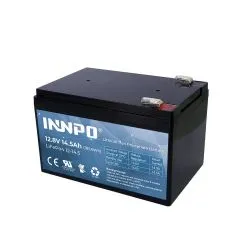
INNPO 12.8V 14.5Ah LiFePO4 Battery
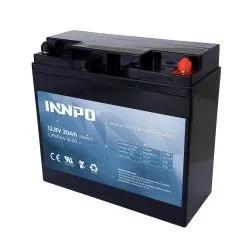
INNPO 12.8V 20Ah Deep-Cycle LiFePO4 Battery
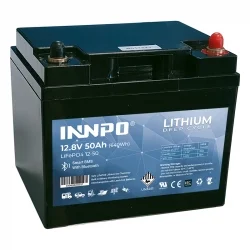
INNPO 12.8V 50Ah Bluetooth LiFePO4 Battery
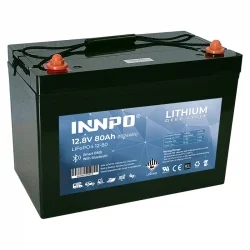
INNPO 12.8V 80Ah Bluetooth LiFePO4 Battery
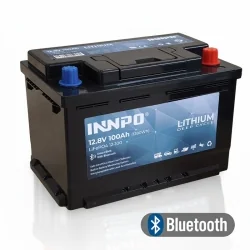
INNPO LiFePO4 12.8V 100Ah Bluetooth Battery
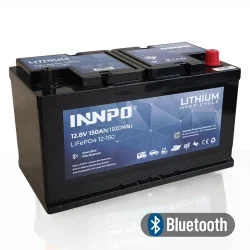
INNPO 12.8V 150Ah Bluetooth LiFePO4 Battery
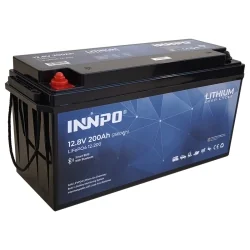
INNPO 12.8V 200Ah Bluetooth LiFePO4 Battery
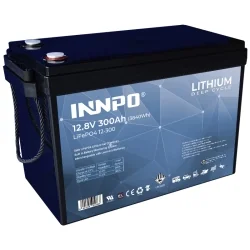
INNPO 12.8V 300Ah LiFePO4 Battery
INNPO 25.6V 100Ah LiFePO4 Battery
INNPO 3.2V 314Ah Grade A Prismatic LiFePO4 Cell