
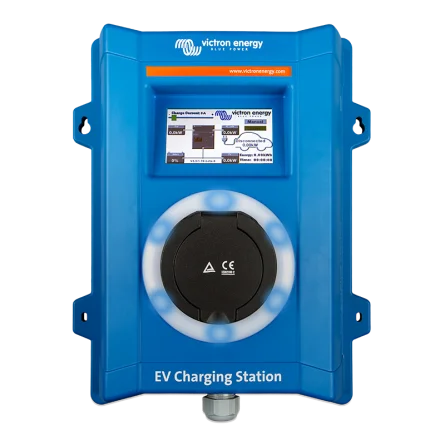

Victron EV Charging Station 22kW for single- or three-phase AC charging, with Type 2 socket, Wi-Fi, Bluetooth and solar-surplus charging mode.
Dimensions: 377 x 307 x 148 mm
EAN/GTIN: 8719076051305
The Victron EV Charging Station is a fixed AC charging point designed for Type 2 electric vehicles. It supports single-phase and three-phase installations and delivers up to 7.3 kW in single-phase or 22 kW in three-phase, subject to the vehicle, electrical supply and installation limits.
It is particularly suitable for homes and businesses that use Victron equipment. Wi-Fi, Bluetooth and VictronConnect simplify setup and monitoring, while integration with a GX device and VRM allows the charger to work as part of a connected Victron energy system.
Manual mode lets the user start or stop charging and select the required current. Scheduled operation provides additional control over charging times. In a compatible Victron installation, solar mode can prioritise surplus photovoltaic energy, helping increase local use of the energy generated by the system.
| Nominal power | 22 kW three-phase / 7.3 kW single-phase |
| Rated charging current | 32A per phase |
| Adjustable output current | 6-32A |
| Input voltage range | 170-265V AC, 50Hz |
| Connector | IEC 62196 Type 2 socket |
| Control | 4.3-inch touch screen, web interface, VictronConnect, GX device and VRM |
| Communication | Wi-Fi 802.11 b/g/n at 2.4GHz, Bluetooth and Modbus TCP |
| Protection category | IP44 |
| Operating temperature | -25°C to +50°C |
| Dimensions | 377 x 307 x 148 mm |
| Weight | 3 kg |
Before purchasing, check that the vehicle uses a Type 2 AC inlet and that its onboard charger accepts the intended single- or three-phase power. The effective charging rate is determined by the lowest limit among the station setting, vehicle, supply and charging cable.
Installation must be carried out by a qualified professional. An external RCD and correctly sized protection, wiring and circuit breaker are required according to the installation and local regulations.
Compare this station with our electric car chargers and Type 2 charging cables. For a solar installation, explore our solar panels, solar batteries and battery monitoring equipment.
No. A 22 kW output requires a suitable three-phase supply and a vehicle that can accept that AC charging rate. In single-phase mode, maximum output is 7.3 kW.
Yes, when it is correctly integrated with compatible Victron monitoring equipment and the system is configured for surplus solar charging.
It supports local control and connected monitoring through the integrated web interface, VictronConnect, a GX device and the VRM platform, depending on the final system configuration.

Data sheet
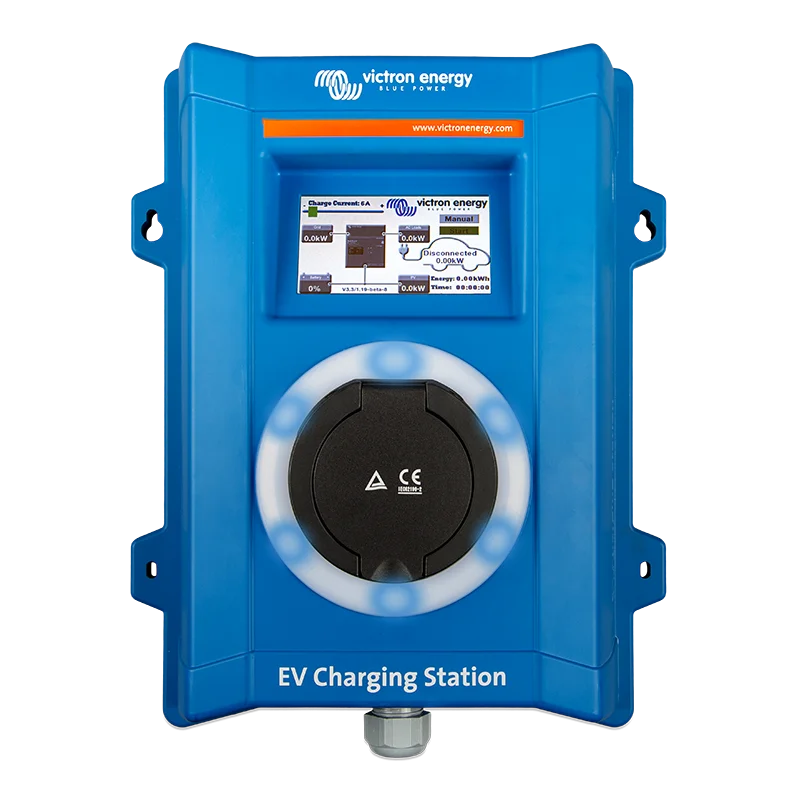
Victron EV Charging Station 22kW for single- or three-phase AC charging, with Type 2 socket, Wi-Fi, Bluetooth and solar-surplus charging mode.
Dimensions: 377 x 307 x 148 mm